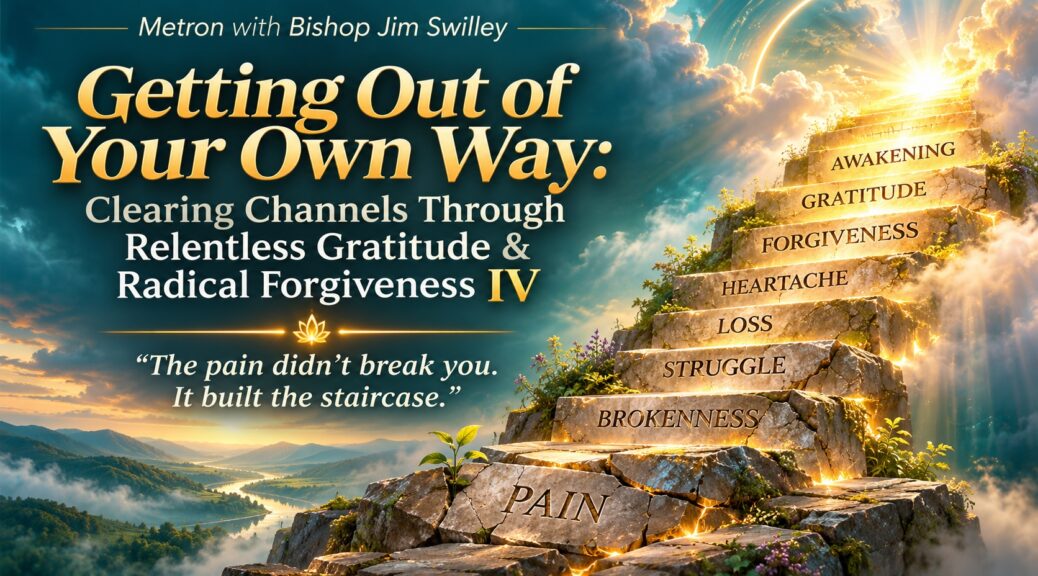
Getting Out of Your Own Way: Clearing Channels Through Relentless Gratitude & Radical Forgiveness IV
Podcast: Play in new window | Download
Bishop Jim’s insightful messages help others find THEIR METRON through
M~otivation E~nlightenment T~ranscendence R~enewal O~utreach and N~etworking
Learn more: www.bishinthenow.com
Follow Jim Swilley on Youtube to see the videos live Sundays at 11:11 am – https://www.youtube.com/bishinthenow
What if the pain you’ve experienced wasn’t the end of your story, but the very staircase helping you rise into a higher understanding of yourself and God? In this thought-provoking installment of Getting Out of Your Own Way: Clearing Channels Through Relentless Gratitude and Radical Forgiveness, Bishop Jim Swilley connects Jacob’s ladder, the mysteries of human suffering, and the transformative power of gratitude. Drawing from Genesis 28, he explores how spiritual awakening happens gradually, one experience and one revelation at a time. Through personal stories, humor, and a fresh perspective on familiar scriptures, Bishop Jim challenges us to stop defining ourselves by our wounds and begin recognizing ourselves as witnesses to our own resilience. The message is clear: you don’t have to understand everything that happened to you to find peace with it. Sometimes the very experiences you wish you could erase become the steps that lead you into greater freedom.
Main Takeaways
1. Spiritual growth happens one step at a time. Jacob’s vision of a stairway connecting heaven and earth illustrates the gradual nature of transformation. Even when you take a step backward, you’re still on the staircase.
2. God has been present all along. Jacob awakened to discover that God was already where he stood. Spiritual awakening isn’t necessarily about reaching some distant destination but recognizing divine presence in your current circumstances.
3. Your pain doesn’t have to define your identity. Bishop Jim explores the shift from identifying with the wound to identifying as the witness. You can acknowledge what happened without allowing it to determine who you are.
4. Gratitude and forgiveness are deeply connected. Relentless gratitude helps create space for radical forgiveness, while forgiveness allows us to discover gratitude even in difficult experiences. Neither requires pretending the pain was acceptable.
5. You don’t have to understand everything to move forward. Human suffering rarely provides simple explanations. Rather than spending your life searching for answers that may never come, you can choose to heal, forgive, and grow.
6. Your experiences can become your staircase. The difficult seasons you survived may have revealed strength, resilience, and understanding you didn’t realize you possessed.
Scriptures Referenced
-
Genesis 28:10–17 — Jacob’s ladder and the revelation that God was present all along.
-
Psalm 37:23 — The steps of a good person are established by the Lord.
-
John 9:1–3 — Jesus redirects attention from assigning blame for suffering toward the possibility of healing.
-
Romans 7:15–20 — Paul’s reflection on the contradictions within human behavior.
-
Ephesians 2:6 — Being raised and seated together in heavenly places.
-
Jeremiah 29:11 — God’s promise of hope within the larger context of hardship and exile.
-
Isaiah 54:16–17 — The relationship between destructive forces and the promise that no weapon formed against you will prosper.
Featured Quote
“You can hate that it happened. It might have broken your heart, but it built the staircase.”
— Bishop Jim Swilley, Metron