‘IF YOUR EYE IS SINGLE: How Mindset and the Power of Your Thoughts Continually Shape and Re-shape Your Reality’ IV
Podcast: Play in new window | Download
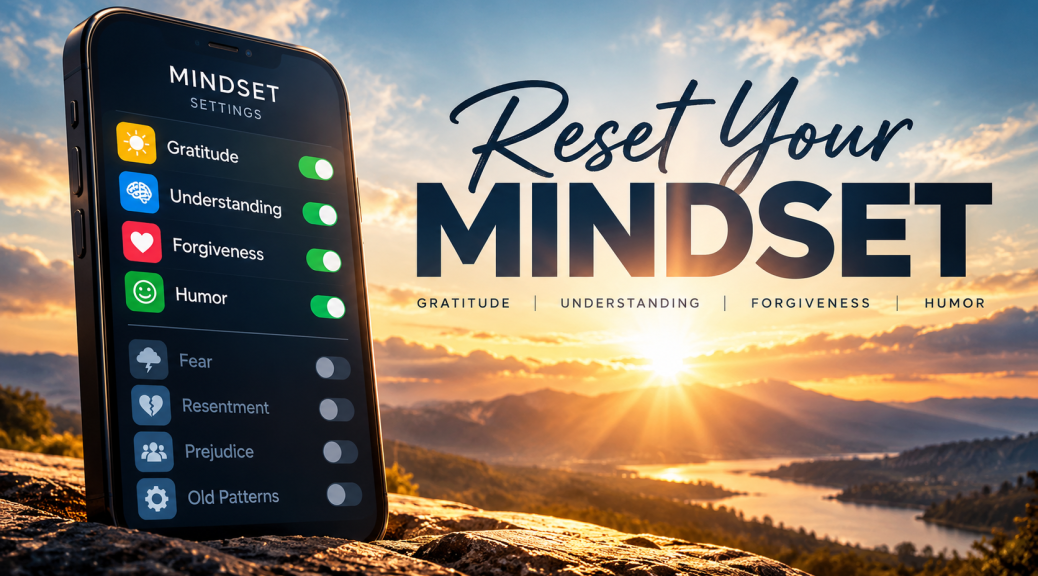
Bishop Jim’s insightful messages help others find THEIR METRON through M~otivation E~nlightenment T~ranscendence R~enewal O~utreach and N~etworking Learn more: www.bishinthenow.com Follow Jim Swilley on Youtube to see the videos live Sundays at 11:11 am – https://www.youtube.com/bishinthenow In this concluding message of Metron’s mindset series, Bishop Jim Swilley reframes being “born again” as something deeper than adopting a religious belief: it is a return to the original way we were created to see ourselves, other people, and the world. Using the analogy of the settings on a phone, Bishop Jim explains that many of our automatic reactions are produced by mental settings accumulated through family, religion, fear, trauma, survival, culture, and experience. Some of those settings once protected or taught us something important, but others have become obsolete and continue triggering reactions long after they are useful. Spiritual transformation, then, involves becoming conscious of those settings and intentionally changing them. Drawing from Jesus’ conversation with Nicodemus in John 3, the message presents being born again as recovering our “factory settings”—learning again to see without inherited prejudice, unnecessary fear, resentment, or limitation. Bishop Jim closes the series by identifying four settings that can reshape how we experience life: gratitude, understanding, forgiveness, and humor. Pasted textMain Takeaways
- Your mindset functions like the settings on your phone. Certain circumstances trigger predictable responses because of settings established in your mind. You may not have consciously chosen every setting, and some may have developed in survival mode, but becoming aware of them gives you the opportunity to change them. This connects strongly with Romans 12:2: “Be transformed by the renewing of your mind.”
- Being born again can be understood as returning to your original spiritual settings. Bishop Jim interprets Jesus’ conversation with Nicodemus in John 3:3–6 not primarily as a formula for getting into heaven, but as a transformation in how we see the Kingdom of God. The emphasis is on returning to what he calls the “original creation”—before fear, prejudice, exclusion, and other learned filters distorted our vision.
- Some settings were inherited rather than consciously chosen. Family patterns, cultural assumptions, religious traditions, painful experiences, and survival responses can become automatic mental programming. Bishop Jim connects this with generational patterns: unresolved fear in one generation can become the worldview handed to the next.
- Not everything you learned needs to be discarded. Wisdom does not mean becoming naïve. Some experiences teach necessary lessons about safety, responsibility, boundaries, and trust. Jesus’ instruction to be “wise as serpents and harmless as doves” (Matthew 10:16) provides the balance: recover childlike openness without abandoning mature discernment.
- Gratitude is the first setting. Instead of continually dividing experiences into good and bad, Bishop Jim encourages viewing life through gratitude—even recognizing that painful experiences can teach, shape, and mature us. This echoes Romans 8:28 and the biblical emphasis on giving thanks in all circumstances.
- Understanding is the second setting. Replace “Why is this happening to me?” with “What is this showing me?” Pain, repetition, and recurring patterns can contain information. If something continually repeats, examine the mental setting producing or interpreting that experience.
- Forgiveness is the third setting. Forgiveness does not require pretending something was acceptable or restoring trust where trust is no longer appropriate. It means refusing to continually rehearse an injury and emotionally relive it. Forgiveness interrupts the cycle that keeps an old experience active in the present.
- Humor is the fourth setting. Learning to laugh—particularly at ourselves—helps loosen the grip of fear, ego, and excessive seriousness. Bishop Jim connects this with remembering laughter in his own family and rediscovering dimensions of people that difficult final seasons can sometimes obscure.
- Transformation requires examining the hidden settings. Bishop Jim invokes Psalm 19:12, “Who can understand his errors? Cleanse thou me from secret faults,” as an invitation to examine subconscious patterns we may not even realize are operating.
- A “single eye” produces a life filled with light. The series ultimately returns to Matthew 6:22: “If thine eye be single, thy whole body shall be full of light.” Change the lens through which life is interpreted, and the experience of life itself begins to change.
Four Settings to Keep
Gratitude → Understanding → Forgiveness → Humor Rather than allowing fear, resentment, inherited assumptions, or old survival mechanisms to remain the default, Bishop Jim proposes deliberately making these four perspectives the settings through which we process life.Quote from Bishop Jim Swilley
“You go through life and you collect these different settings that are obsolete now, and they’re not serving you.” — Bishop Jim SwilleyThat statement captures the central idea of the message: spiritual growth isn’t necessarily about becoming someone entirely new. Sometimes it is about identifying what has accumulated over the years, keeping the wisdom, deleting what is obsolete, and returning to the clearer vision that was there before fear taught us how to see.