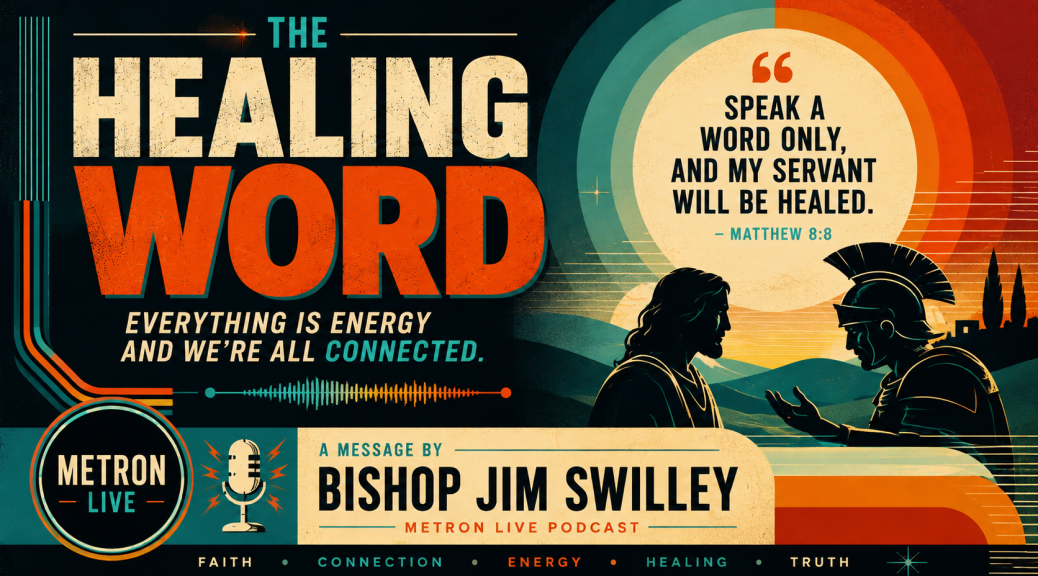
THE HEALING WORD: Everything Is Energy and We’re All Connected Pt. II
Podcast: Play in new window | Download
Bishop Jim’s insightful messages help others find THEIR METRON through M~otivation E~nlightenment T~ranscendence R~enewal O~utreach and N~etworking
Learn more: www.bishinthenow.com
Follow Jim Swilley on Youtube to see the videos live Sundays at 11:11 am – https://www.youtube.com/bishinthenow
Bishop Jim Swilley continues “The Healing Word” by exploring healing not simply as something that comes vertically “from God,” but as something that also moves horizontally through human connection, relationships, words, thoughts, and presence. Beginning with Jesus healing the centurion’s servant from a distance, Jim considers how difficult circumstances can actually become catalysts for revelation. The message moves into the power of our thoughts and intentions, while avoiding the simplistic idea that every negative experience is something we somehow attracted. Ultimately, the emphasis is on connection: sometimes the healing word is encouragement, sometimes it is simply hearing the voice of someone you trust, and sometimes it is an uncomfortable truth spoken by someone who loves you. Healing happens as we remain open, nurture our relationships, release offenses, reframe painful memories, and become intentional about the energy and words we send into one another’s lives.
Main Takeaways
1. Sometimes the negative becomes the catalyst for revelation.
Jim returns to the Roman centurion who tells Jesus, “speak the word only” and his servant will be healed. The centurion understood that physical proximity was not necessary for healing. Jim’s larger point is that circumstances that make us uncomfortable, insecure, rejected, or seemingly trapped can sometimes push us into seeing possibilities we would never have considered otherwise.
Scripture: Matthew 8:5–13; Romans 8:28; Hebrews 11:7
“Sometimes the worst thing that ever happened to you may be the best thing that ever happened to you.” — Bishop Jim Swilley
2. The healing word is not limited by distance.
Psalm 107 says that God “sent his word, and healed them.” Jim connects this with prayer, positive intention, “sending good energy,” and simply intentionally holding another person in your thoughts. Different people may use different terminology, but the underlying idea is connection that transcends physical distance.
Scripture: Psalm 107:20; Matthew 8:8
3. Healing is horizontal as well as vertical.
Spirituality is not only about our relationship with God. Jim emphasizes the importance of the “horizontal beam” — our relationships with one another. Jesus connected loving God with loving our neighbor, making human relationship an essential expression of spiritual life.
Scripture: Matthew 22:37–40; Ecclesiastes 4:12
“It’s the relationships in your life that reveal the Christ to you.” — Bishop Jim Swilley
4. Prayer should seek agreement rather than control.
Prayer can become unhealthy when it is really an attempt to make another person’s circumstances conform to what we think should happen. Jim argues that before praying for someone, we should understand what that person actually wants rather than assuming we know the proper outcome.
Scripture: Romans 8:26; Matthew 18:19
5. Mature spirituality moves beyond everything being simply good or bad.
Using the imagery of the Tree of Knowledge of Good and Evil versus the Tree of Life, Jim challenges binary thinking. Heroes can be flawed. Villains can be wounded people. Painful circumstances can produce unexpected growth. The cross itself demonstrates that suffering and resurrection can exist within the same story.
Scripture: Genesis 2:9; Hebrews 12:2
6. Unreleased offenses can keep the past alive in the present.
Jim uses Charles Manson as an extreme example of what can happen when someone continually collects offenses and interprets everything through what has been done to them. The lesson is not to deny what happened, but to process it rather than allowing yesterday’s pain to dictate tomorrow’s behavior.
“When you keep collecting offenses, it makes you crazy after a while.” — Bishop Jim Swilley
7. Our thoughts matter, which makes intentional living both freeing and challenging.
Jim shares a message from Charles McFall responding to the statement, “Every thought I think is creating my future.”
“It is as freeing as it is terrifying. Living without intent is scary and it’s hard work to always be intentional.” — Charles McFall
Jim acknowledges the tension: we cannot simply turn off unwanted thoughts. The practical work is learning how to reframe them rather than repeatedly allowing painful memories or fearful projections to control the present.
Scripture: Romans 12:2; Philippians 4:8
8. Sometimes we need someone’s presence more than their advice.
Jim describes calling someone close to him during an intense week and deliberately not talking about what was troubling him. The conversation itself was enough. Sometimes healing energy comes through familiarity, connection, a trusted voice, or someone simply saying, “It’s going to be okay.”
Scripture: Proverbs 17:17; Galatians 6:2
9. A healing word isn’t always a comfortable word.
Like medicine, something can hurt while ultimately helping us. Someone who genuinely loves us may tell us something we do not want to hear. Healthy relationships create enough safety for truth, vulnerability, correction, and growth.
“A healing word sometimes is an uncomfortable word. It’s a challenging word.” — Bishop Jim Swilley
Scripture: Proverbs 27:6; Ephesians 4:15
10. Relationships are worth maintaining because we need connection.
One of the strongest conclusions of the message is that independence should not become isolation. Keeping relational “airwaves clear,” releasing unnecessary offenses, communicating honestly, and understanding how different people connect can become part of our own healing.
Scripture: Ecclesiastes 4:9–12; 1 Corinthians 12:20–21
The Central Thought
You cannot control every thought that enters your mind, every painful memory, every difficult circumstance, or every unknown in your future. But you can change the framework through which you interpret them. Instead of repeatedly wounding yourself with yesterday, you can extract whatever truth is useful, release what belongs to someone else, and remain open to the people whose presence brings healing into your life.
“Hang on and keep staying open and get outside of yourself and let people speak into your life and nourish and nurture your relationships, because you never know when you’re going to need that person.” — Bishop Jim Swilley